

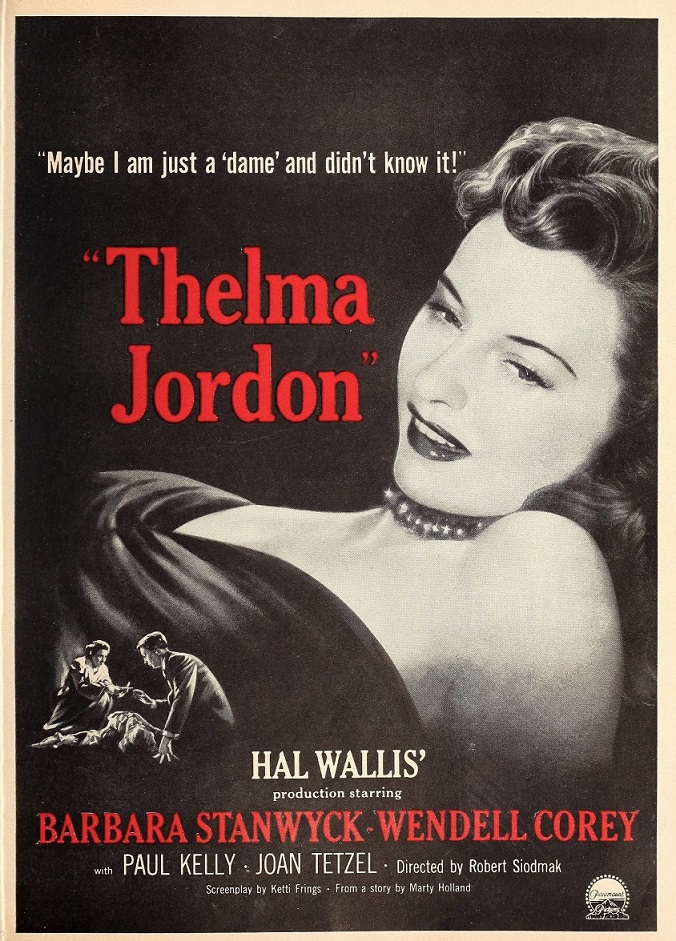
Originally released as just Thelma Jordon, the movie would star Barbara Stanwyck in yet another film noir, a genre that she would excel in over the years, and would end up playing with and against Wendell Corey. While the former would grab the attention of the audience immediately as soon as she would come on  the screen making people hang on to her every word and action, so too would Corey, unassuming at first until his destiny would intertwine with Stanwyck’s, a mistake he would never see coming until it was far too late.
Playing the titular Thelma Jordan, Stanwyck was once again perfectly cast and here she would portray the damsel in distress, a woman looking for help and getting it in the least likely of places in the form of Cleve Marshall, a district attorney who would rather drink himself into a stupor instead of going home to his family. The two would go off together to get a drink, a drink that would soon turn into far more as a kiss would manifest between the two. One can say that Cleve, the character that Corey plays is doomed, entangled in a web he does not even know has been spun as of yet, but he walks into it with eyes wide open, the man thinking it 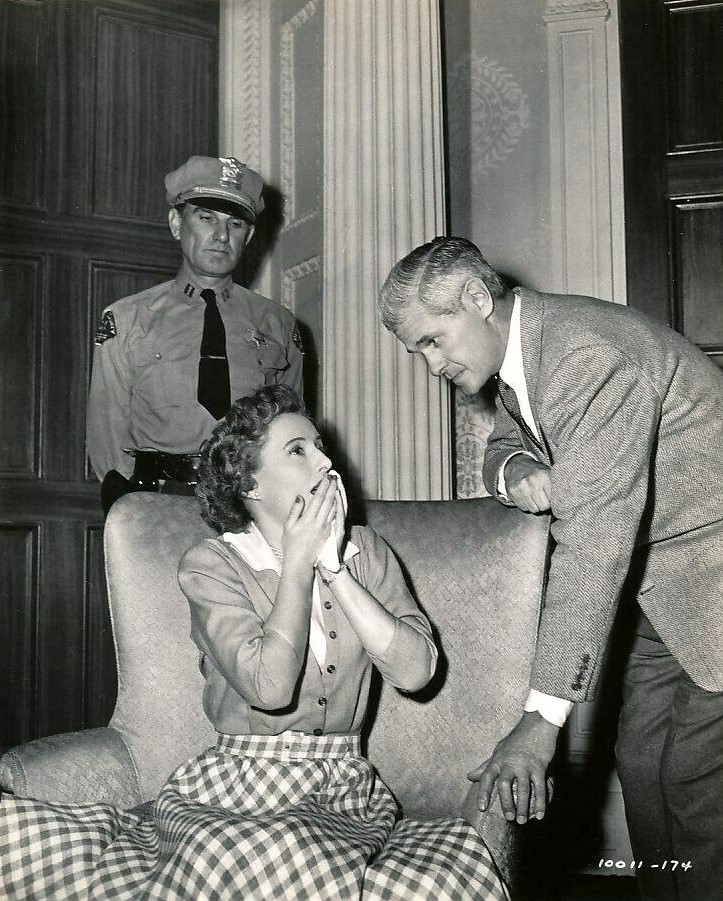 love until there is nowhere to go except forward, even though he knows not where it leads.
Directed by Robert Siodmak, the man no stranger to film noir with movies such as The Killers in his back pocket, he would begin the picture off slowly so that one might think it a romance or straight-up drama, but as it would progress, he would begin to show his hand. Little by little through Stanwyck’s character, she would turn out to be not as she seemed and caught up in it would be Cleve, who for his part, was exactly as advertised. Working from a script by Ketti Frings and featuring some incredible photography from George Barnes, Siodmak would take his time unveiling what was to come and he would do it on darkened roads, with furtive glances, but more importantly, through the actions of the leading players. Stanwyck and Corey worked well together, bringing out the best in each other’s performance and it would be almost impossible for people to tear their eyes away as the drama unfolded. Additionally, Paul Kelly and Joan Tetzel would star to round out the cast, the two of them completely in the dark as to what was 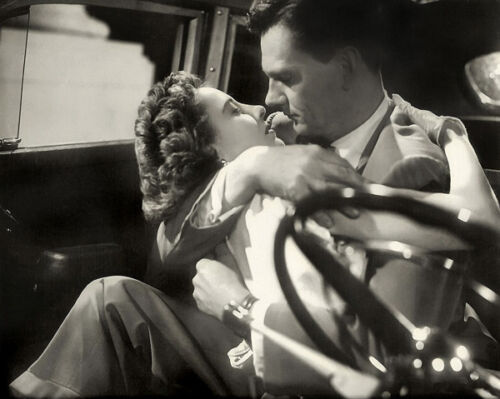 happening and making the tension that takes place all the more sharp.
All of it would come to a crescendo in the final act, taking place in a courtroom where Jordon would walk away unscathed, but paying for her deceit later in a scene that might have been a little cliché, but nevertheless played out perfectly, summing up all that had happened and leaving things off not on the happiest of endings, but one that at least would let Cleve off the hook. As it turns out, no matter how complicated it might be, love is a wild card no matter what form it might take and despite the two characters coming together as they did, they discovered that neither, in the end, were exactly who they thought they were. The File on Thelma Jordon may not be talked about in the same circle as The Killers or Double Indemnity, but it should not be dismissed as anything but a solid and brilliant little thriller with Corey and Stanwyck in excellent form.
4 out of 5
Categories: Movies and Film, Mystery/Noir
 The Telltale Mind
This movie is much better than a lot of the critics rate it. What is interesting is that, like many of Stanwyck’s earlier movies, it seems in many respects a psychological (v. actual) portrait of Stanwyck herself writ large as one can only imagine from her biography, which my explain why she plays her role as so well here. Reportedly orphaned in Brooklyn at a young age and unruly in her youth, never remaining in any one home or school for long and known for fighting, going on to become a chorus girl at fifteen having early discovered her attraction to men, only to rise above the common fold and become a star by sheer ambition gives her credibility in noir roles. We identify with Wendell Corey’s Assistant DA’s character here precisely because we, also, don’t want to accept the liklihood that Thelma is no good, and it is wrong to say, due to Stanwyck’s strong performance, that, of course, we should have known it all along. And then just as we (both Corey’s character, and we the viewer) conclude that we should have known all along, we discover that we were not entirely wrong in wanting to believe in her- oh, by the way while simultaneously discovering that she herself, and not ‘Mr. X’, was the actual killer (x2, in the end)- which is some kind of a double (triple?) twist.
LikeLiked by 1 person
Make that, ‘…that she herself, and not Jordan or the alleged jewel thieves, was the actual killer’. By the way, Thelma must have known about the redrafting of the will in her favor, and the murder of her Aunt must have been premeditated- why else would she have let the shutters crash to draw her Aunt downstairs to be shot, when she might have simply stolen the jewels and blamed alleged jewel thieves if that was all she was really after, which may mean that she was lying even on her death bed when she suggeted that she only shot her Aunt as an automatic reaction to the fact that her Aunt had a gun on her that she didn’t know she had.
LikeLiked by 1 person