

Night Has a Thousand Eyes is a 1948 motion picture based upon the novel by Cornell Woolrich, a tense film noir that finds Edward G. Robinson as a man who can see the future. To say it is an odd role for the man is quite true, but at this point in his career he was branching out and trying new things and being successful at it too. He would still play the occasional gangster or bad guy, but his dramatic roles would end up being some of his best, including this one as an unlikely prognosticator. Robinson delivers a very subtle performance, one that is perfectly suited to his character, a man who makes a living by ‘predicting’ the things in people’s lives, a con seen many times to greater or lesser effect. 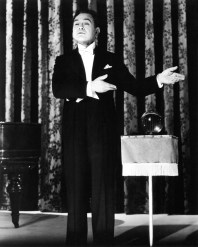 It all starts to go awry when he finds he has an actual ability that will indeed tell him the future. After his best friend uses him for financial gain, John Triton as played by Robinson, starts to fear his power as more often than not, he sees someone’s death and is unable to do anything about it.
It is not often you find a film that features fortune telling or what have you outside of a comedy or a fantasy of some sort and yet here in this movie directed by John Farrow and in this particular genre of all things, it is the crux of the entire picture. Robinson’s performance is on par with Chaney’s from The Wolf Man, portraying a man with an overwhelming sense of guilt for the things he perceives are his fault. The two roles are quite similar as Chaney could not help what the wolf did, while Robinson’s character could not change the course that fate had set out. Both men would do their best and yet, both were doomed and they realized it. 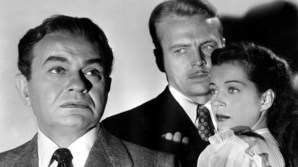 The movie is utterly compelling because of it, watching Triton trying to change the course of things and failing every time. There is an ultimate futility in his actions and yet for some reason, he refuses to give up even though each loss is a soul-crushing one. It is only when he meets the daughter of his best friend whom he failed to save and receives a vision about her death that he becomes hardened in determination. He will save her no matter what, even if it should cost him his own life.
The film would also star doomed actress Gail Russell, a woman who in life could not control her demons and die at the early age of thirty-six. Here she is still in the prime of her life and puts in such a good performance that you could never tell anything might have been wrong behind the scenes. John Lund and William Demarest also co-star and the supporting cast is just as good as Robinson, though he does tend to steal the show. Of course, nobody believes Triton and his predictions. 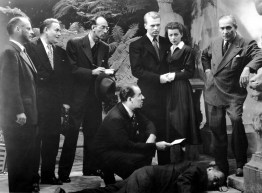 Though they all come true, most think of it as a trick, something he must be doing on the sly somehow and no matter what he says or does, it is still looked at in just that way. Only Jean, Russell’s character, believes him and that is perhaps due to him predicting her father’s death and then the various images which would lead to her own. At the end of the film and after everything that happened, most still never believe him, but it matters little at that point as Jean is safe and the real villain of the piece captured.
Highlighted by strong performances, a tense and moody atmosphere and a lead character doomed by his own predictions, Night Has a Thousand Eyes is a captivating and thoughtful example of film noir. It is perhaps a little different than the usual fare featuring your classic good guys and bad guys, but no less effective and mysterious because of it.
4 out of 5

Categories: Movies and Film, Mystery/Noir, Suspense/Thriller
 The Telltale Mind