
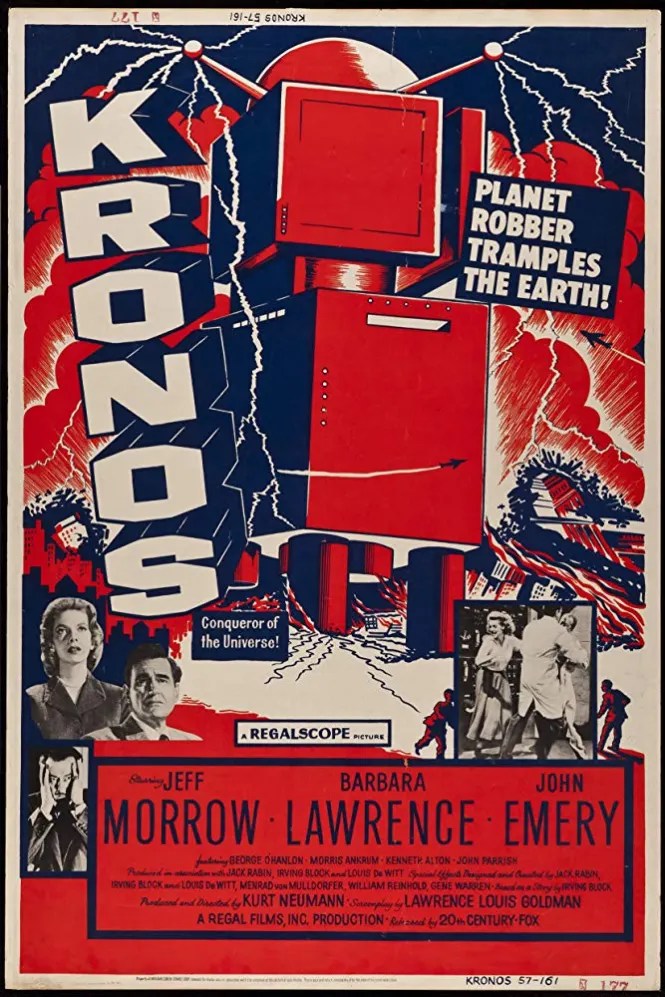
The 1957 science fiction film Kronos, directed by Kurt Neumann and produced by Regal Films, is a surprisingly thoughtful film at a time when atomic monsters and Cold War paranoia dominated the big screen. When all was said and done, despite the rampaging robot, it offered something a little more cerebral within its frames, blending atmospheric storytelling with cautionary themes about energy consumption and the advancement of technology.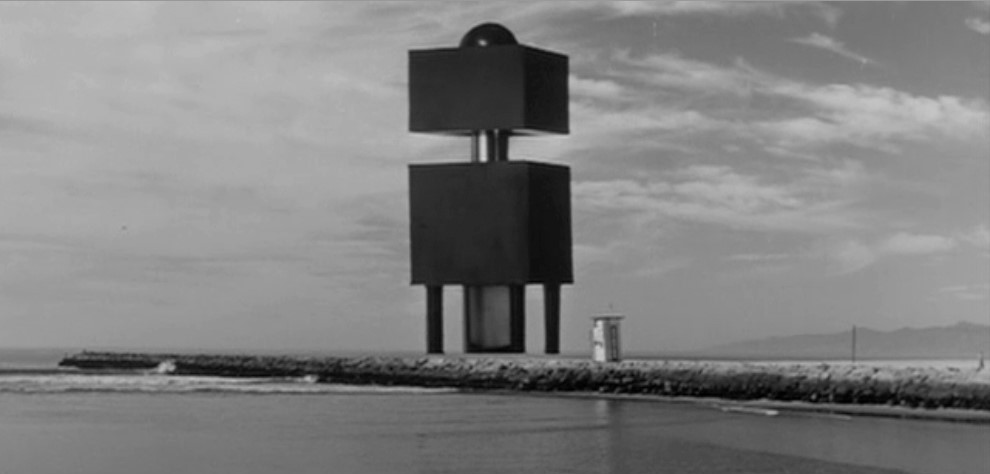 The movie opens with a strange, pulsating object hurtling towards Earth, where it eventually takes control of Dr. Hubbell Eliot, a scientist at the government research facility, Lab Central. From there, we are introduced to Dr. Leslie Gaskell, as played by Jeff Morrow, his assistant Dr. Arnold Culver, portrayed by George O’Hanlon, and the woman behind the man, Gaskell’s love interest, Vera Hunter, depicted by Barbara Lawrence. As they investigate a series of anomalies, including mysterious power surges and a large impact off the coast of Mexico, it becomes clear that something is up. Soon enough, a massive, robotic machine rises from the ocean, unlike its other celluloid brethren, as it does not rampage or kill or the like. Instead, the titular machine absorbs energy, all kinds, whether it be mere electricity or that found in an atomic bomb. It continues to do so throughout the movie, and all the while, it grows larger and larger as it is on a mission, looking to revive the planet of its alien masters, whose resources have been disastrously depleted.
This makes Kronos not only interesting but also notable as one of the earliest science-fiction films to tackle topics like the environment, its destruction, and the loss of resources caused by that ever-consuming force called humanity. The film actually has a message, and it strikes a chord, as it must have when it first premiered nearly seventy-five years ago. As humanity expands outward, both geographically and in its broadening knowledge and understanding, discussing the increasing consumption of energy and resources is quite novel. It makes the audience wonder if the robot is the actual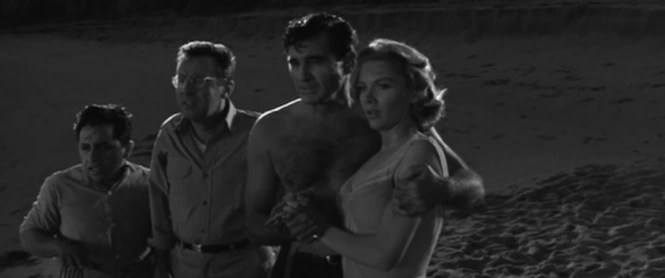 villain or their fellow man.
The special effects, both practical and the animation, while not the greatest ever captured on film, were surprisingly quite good. The robot is made to look gigantic in size. Its blocky, simple-looking design is just as effective here as it has been in other movies. With its geometric look, the alien device has a chilling presence, a totally inhuman automaton, devoid of thought or feeling. The animation used to make it move might not have been as slick as it could have been, but it was still highly effective and worked perfectly for what the filmmakers were trying to achieve. The best thing about it is the unintended consequence of injecting just a touch of horror into the proceedings. As for the cast, they were competent with O’Hanlon being the best of the bunch. The rest are good, and they shine a little brighter when dealing with the robot as it rampages on its way, making it compelling viewing.
Kronos is a film that is not discussed as much as others of its ilk. Despite its immense size and the destruction it causes, the fact that it does not intentionally harm humans might be the reason it is held back. It deserves more recognition than it gets, and the thematic elements within speak more to the current state of affairs than they ever did before.. While not as flashy or famous as some, it is well worth checking out for fans of vintage science fiction.
3.5 out of 5
Categories: Movies and Film, Science-Fiction
 The Telltale Mind