
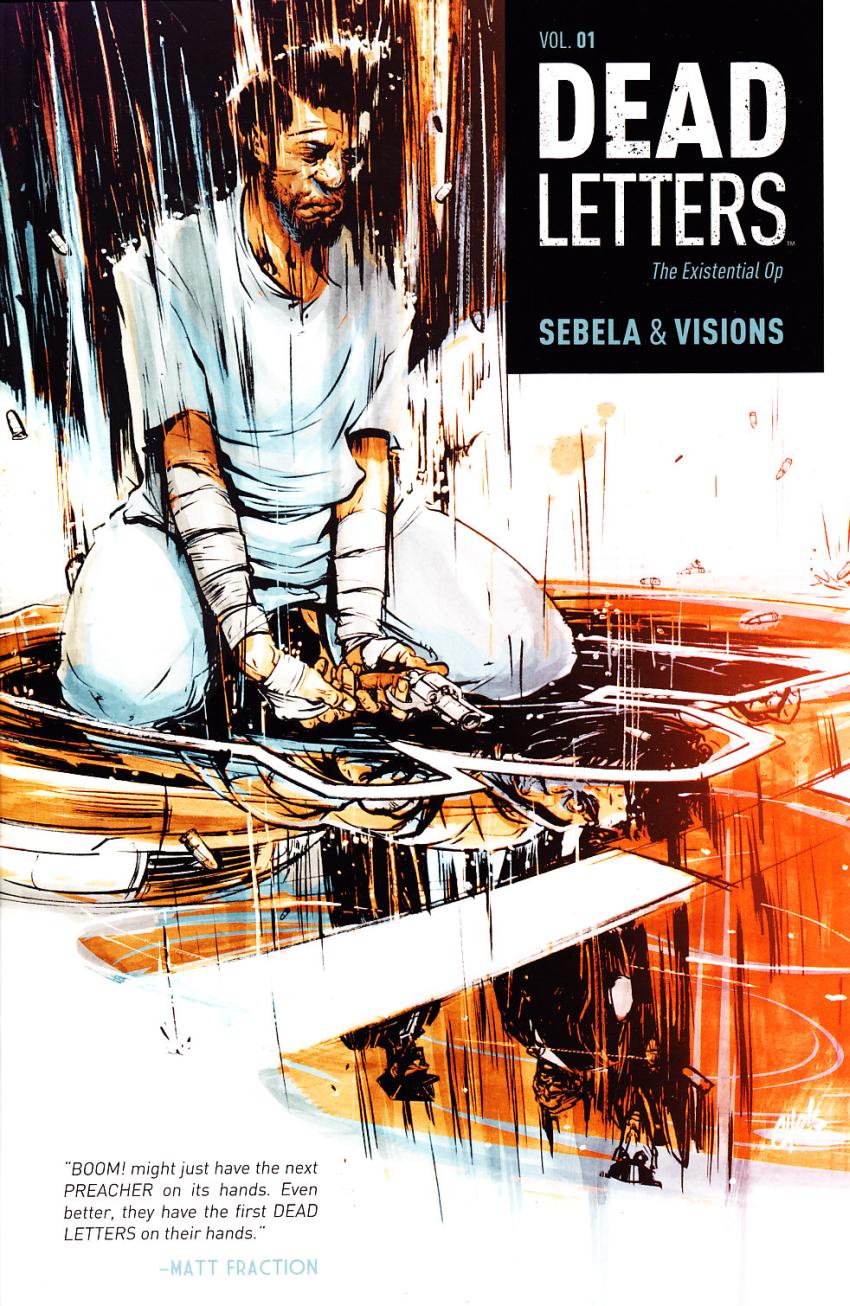
The one thing this series expunges more than anything is possibilities. It does so because Christopher Sebela has created a world where they are endless. Almost any type of story could be told here and all of them in any fashion imaginable as this world, which just so happens to be the nether-realm of Purgatory, has absolutely no rules. This first tale falls into the crime genre, one already ripe with story ideas, with a few other sub-genres making their way in as well, like religion, action, noir, humour and even a hint of horror. Dead Letters is a melting pot of ideas that come together and takes the reader and its leading man on a trip through a world where things are not always what they seem and everyone waits to find out what comes next.
At first the book was a little confusing as writer Sebela decided to skip the usual and expected introduction and dive head-long into the action with strange looking characters that cannot seemingly be killed. After a lot of drama and a little more action, the explanations come and the reader is introduced to the Here, the place where people end up after they die or as previously stated, Purgatory as it is more commonly known. It is in this place where souls come to await their fate, whether they go back, go up or go down. Wherever it might be, there is always the waiting. Sam, our lead character wakes up in the Here and after some information from various parties, he discovers himself working for God, indirectly of course, as well as two different gang leaders who are vying for control of the Here. It is a little maddening for Sam as he tries to figure out what is going on, especially as he would simply like to just survive the day and perhaps get a little sleep. So it is that Sam finds himself playing all three sides against themselves, four if he counts himself, and not knowing what the outcome will be.
The artwork by Chris Visions was both quite different and good because of it. It looked like he sketched out his page as an artist is wont to do and then did the finishes over top of them, which is normal, but failed to erase those underlying pencils. By doing that, it actually lends a certain energy to the pages and is quite fascinating to look at. Why he chose to do it this way was perhaps a little strange, but it does work well and gives the book a uniqueness not present in most titles. Sadly, the art did have one downside which was the inking and the colouring. At times the book would look a little too dark, almost giving the artwork a muddy look. Whether it was by choice or simply bad film at the printers is unclear, and while it did add to the story’s crime and noir element at times, it would have been preferable if the colours and inks were a little lighter at times. In the end, it did not ultimately take away from the book; it just would have been a little better.
There are a lot of concepts in this book, a lot of things jammed into these four issues that surprisingly, Sebela manages to keep all sorted and balanced. It is an extremely uncommon story and is a case where comic books prove they can be the perfect medium for these types of stories. Could Dead Letters make the jump to film or television? Maybe, but sometimes the best way to enjoy a story is the way it was intended. While the book has a little of something for everyone, it is definitely a tale that takes a little patience to read. Should you give it a shot though, you might be pleasantly surprised by this unconventional crime drama.
3.5 out of 5
Categories: Comics
 The Telltale Mind