
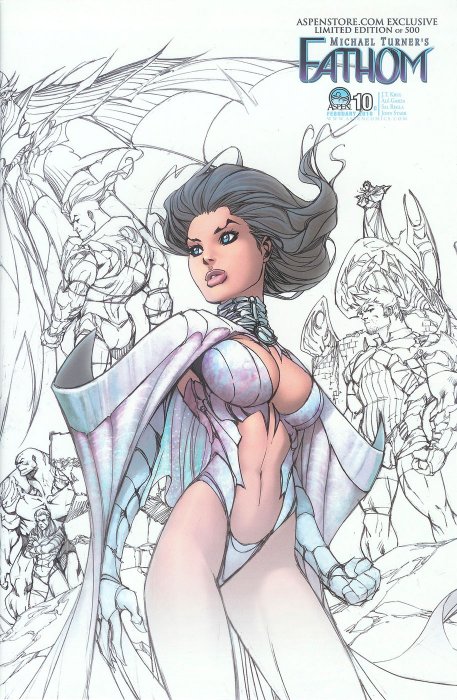
Jumping into the third volume of Fathom, it feels familiar as it jumps back into a war with the humans. It is fair to say, that come the end of the second volume, that war never really ended, merely paused. Of course the instigator of the latest attacks is Killian, keeping his year’s long grudge burning bright. This time he also has Kiani by his side, his family reunited and her hatred burns even hotter than his. And as Killian wages his war, the Black have also had enough with the humans and their slow but inevitable destruction of the planet and also decide to take the fight to them, but with a more permanent solution in mind. In the middle of it all are the Blue and Aspen, looking to make peace with the humans and to settle things once and for all.
There is a lot going on in this series, most of it good, and the first being the story. J.T. Krul does a good job with this installment of Aspen’s ongoing struggles between the three sides of her nature. Being of the Blue, the Black and raised among humans, the latest volume continues to chronicle her exploits, this time as a mediator between the races as according to Siphon, the new leader of the Blue, she is the perfect candidate. Aspen agrees of course, if only to keep an eye on Killian. Krul also makes Aspen the strongest we have seen her so far, and much more interesting than the two previous series she was featured in. Where Killian stole the show in the first series, and Kiani the second, Aspen finally gets to shine in this one. Another couple of items to note is a larger part for Aspen’s boyfriend Chance, and he actually turns out to be something of an interesting person as well as some new villains on the human side which will make future stories refreshing.
The Black, while not new, are a very intriguing people. We do not know much about them, and still very little is dealt with them or their background. But the water is life, and the Black were there in the beginning, so to see them take out their aggression on the humans makes perfect sense as the human population is not doing so well with their charge. Hopefully the Black will have a series of their own at some point, or at least get featured in a much larger capacity further down the road.
Kiani, who did have a much larger role in the last volume, as well as starring in her own miniseries before this story launched has somewhat of a smaller part to play in this story. She is still with her father, whom she joined in her own series, but when we see her, her character is very one dimensional. There is not really any give or take or any real explanation, especially for new readers, why she is doing what she is doing. Yes, she is mad at the world, but it is never really dealt with which is a little frustrating after setting her up as a major player for so long.
This leads us to a bit of writing that is not necessarily bad, but an instance of characterization that does not ring true, and in this case, it is Killian. Ever since the creation of the Fathom universe, we have been shown how Killian hates the human race. He hates it with a passion that is deep and has lasted for so many years; it is almost all he knows now. It is the hate that Doom feels for Reed Richards but magnified to a much larger scale. But when Killian hears of Siphon’s plans to broker peace with the humans, a switch flicks in his head and he suddenly forgets everything he has been fighting for and all is good with the world. It was very strange, very abrupt and a drastic move away from who and what Killian is.
War does seem to be an ongoing theme in the Fathom universe. So far it has taken up quite a large chunk of the published series. Whether it is between races or characters, it has touched almost every aspect of every book so far. It does make for interesting reading, but it would be nice to see the books move in another direction at some point. Redemption is also an ongoing theme most books feature as well, such as Cannon receiving his in the second series and Killian in this one. Even Aspen herself gets a little redemption, though hers comes from within, finally accepting who and what she is.
Art-wise, Ale Garza really brings it home on this series. While Marcus To had a bit more of an anime look about the characters, Garza has a bit more of a modern-standard feel about them. His style is almost like a cross between J. Scott Campbell and Jim Lee, which turns out to be a good thing for us. His pencils are quite gorgeous to look at, and most often you find yourself admiring the intricacies of it such as Aspen in her new white armour. Helping him out were Sal Regla on inks and John Starr on colours. Together they brought the world to vivid life and the results are fantastic. Yet again though, a different artist for the third series in a row, but one that works well as it sets each chapter apart.
Altogether, volume three of Fathom was a much stronger series than volume two was. There was one minor fumble, albeit most especially strange, and while it should have been explored in this series, perhaps they can do so in a future one. Great story, great art and nice to see Aspen take the spotlight for her own.
4 out of 5
Categories: Comics
 The Telltale Mind